

.

FREE SHIPPING
Our Door to Your Door Without Any Trouble
COD AVAILABLE
You Can Pay Amount at The Time On Delivery

Buy from Amazon
We are Amazon’s Choice & Prime Tag Achiever. Visit
100% Sheep Wool | Handmade | No Polyester
-
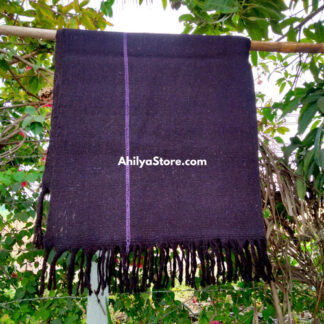 Original Light Weight Black Ghongadi(Jawal) | 100% Premium Sheep Wool | 96×48 Inch₹2,300.00
 -
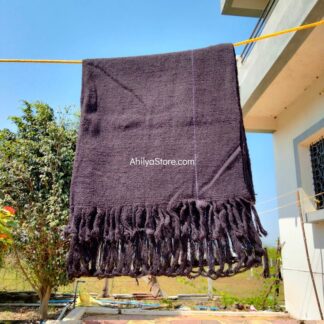 Original Light Weight Black Ghongadi(Jawal) | 100% Premium Sheep Wool | 108×48 Inch₹2,600.00
 -
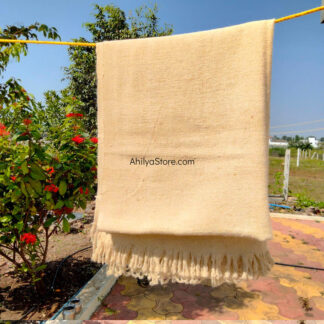 Original Light Weight White Ghongadi(Jawal) | 100% Premium Sheep Wool | 108×48 Inch₹3,000.00
 -
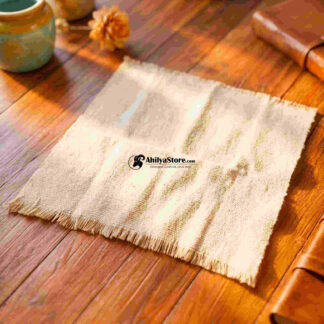 100% Pure Sheep Wool White Meditation Mat | Premium Sheep Wool | 2.5×2.5 Feet₹1,000.00
 -
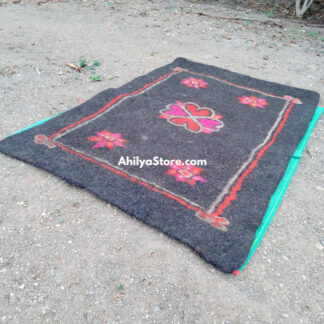 Handmade Heavyweight Black Woolen Jen | Regular Wool | 6×4 Feet₹3,000.00
 -
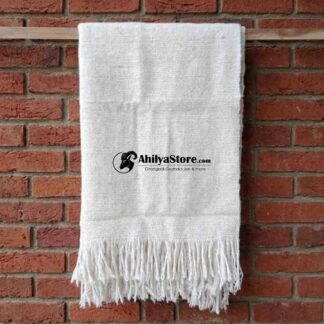 Original Light Weight White Ghongadi(Jawal) | 100% Premium Sheep Wool | 120×42 Inch₹3,000.00
 -
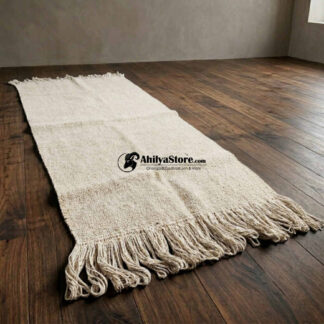 Handmade Pure Sheep Wool White Yoga Mat | 100% Premium Sheep Wool | 6.5×2.5 Feet₹1,500.00
 -
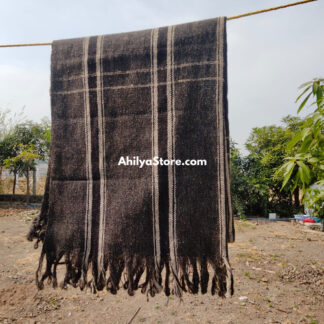 Admapur Grey Ghongadi – 9*4 Feet₹2,600.00
 -
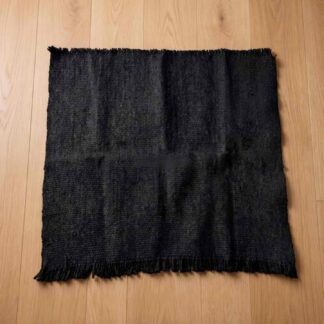 100% Pure Sheep Wool Black Meditation Mat | Premium Sheep Wool | 2.5×2.5 Feet₹1,000.00
 -
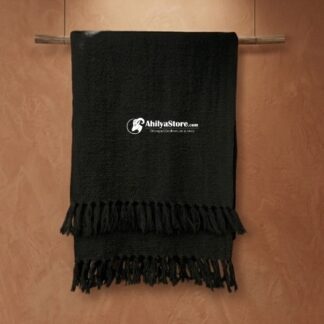 Original Light Weight Black Ghongadi(Jawal) | 100% Premium Sheep Wool | 120×42 Inch₹2,600.00
 -
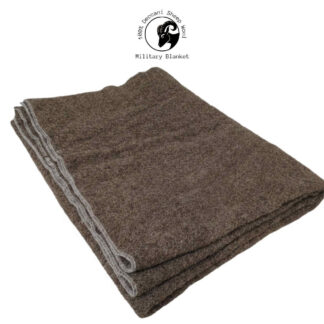 Military Ghongadi Blanket – 7×5 Inch₹3,000.00
 -
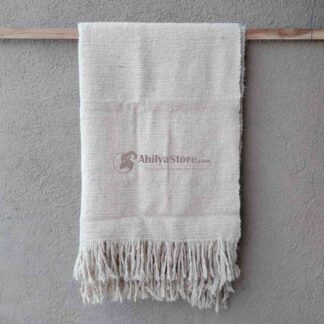 Original Heavy Weight White Ghongadi | Regular Wool | 120×42 Inch₹2,600.00
 -
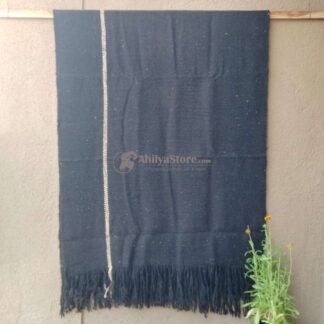 Original Heavy Weight Black Ghongadi | Regular Wool | 120×42 Inch₹2,600.00
 -
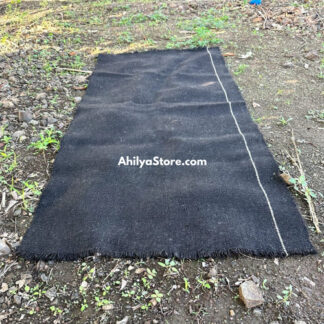 Black Woolen Yogamat₹1,500.00
Why Should You Purchase GHONGADI From Us?
- All sheep wool blankets are entirely handmade on traditional looms.
- Extremely fine quality wool is used in the blanket-making process.
- High product quality without any adulteration.
- AhilyaStore.com is the only brand from Maharashtra delivering original Ghongadi made on traditional handloom.
- A direct connection between the artisans and their customers, a major chunk of the profit is shared by the artisans.
- Every final product is verified by our quality control officers and is delivered to the customers at their doorstep on time.
- Free Home Delivery, COD Available.
What is a GHONGADI or KAMBALI or KAMBLI?
Ghongadi is a cultural and spiritual inheritance of deccan plateau. Shahir Nivrutti Pawar’s unforgettable folk song ‘kathi na ghongada gheu dya ki re an mala bhi jatrela yeu dya ki re’(let me take my stick and woolen blanket and accompany you to the funfair) or the line from Pandit Bhimsen Joshi’s verse ‘kanhoba tujhi ghongadi changli re’ (boy, your woolen blanket is good) reminds us of the fond memories associated with Ghongadi which still makes it so relevant in the villages of western Maharashtra. The artisans’ community involved in preserving this art are fast depleting and are alive today only in fewer villages of Satara, Solapur, Kolhapur and Dhule district of maharashtra and other states like Karnataka, Telangana, Andhra Pradesh.
The “Ghongadi” is a regional name given to a khadi Blanket. which is hand spun, hand woven in pure Desi deccan sheep wool Produced by the Shepherds Community of Dhangar from rural parts of Maharashtra (One of the prime states of India). The woolen Blanket “Ghongadi” is known by various other names such as “Kambal” in north india, “Kuri Blanket” in Karnataka, “Kambli” or “Kambali” in Telangana and Andhra Pradesh.
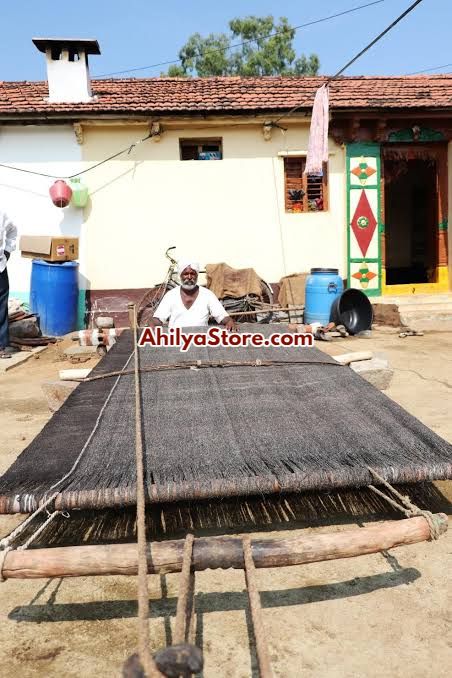
Vinutha Mallya (2017) says that the any Community dealing with Wool related supplies are believed to be the nomadic community of the shepherds, who breed, herd, posse and maintain the sheep and this maintenance involved timely cutting their hair. The Shepherd then sell these hairs to the Sub- Community who could make yarns out of those hairs, which are hand spun, naturally processed enabling them to weave together using a basic floor loom into the fabric- known to be as “Ghongadi”.
The manuscripts state that farmers and peasants used a single Ghongadi as a bedspread and blanket while they spent their entire day in farms since it was 12 feet long. With reference to historical events, it has been said that Chhatrapati Shivaji Maharaj handed every mavla(soldier) to such woolen blankets to protect themselves. The great Indian social activist, Mahatma Phule was never seen without a Ghongadi on his shoulder.
The wise men from the Dhangar (shepherd) community predicted about monsoons by the amount of dust settled on the Ghongadi. Will it rain abundantly? Will the fields prosper? The answers to these questions were believed to be God sent messages to the common people by understanding the status of this woolen blanket while Ghongadi resting on the Malhari’s shoulders was considered to be a symbol of prosperity and stability.
Ghongadi is an indivisible part of the shepherd who till date is pictured as a man wearing dhoti and a turban with ghongadi on his shoulder and a stick for his flock of sheep. With our initiative, AhilyaStore we provide a platform to connect these artisans from the Dhangar community, their roots and traditions and the art of Ghongadi making to the rest of the world.
Benefits of Sheep Wool Blanket – Ghongadi
Ghongadi is a traditional, hand-woven woolen blanket from Maharashtra, India. It’s known for its warmth, durability, and a variety of uses beyond just keeping warm.
Here is a summary of the benefits and uses of a ghongadi:
Health Benefits:

- Relief from body aches: Sleeping on a ghongadi is believed to help with back pain, joint pain, arthritis, and spondylosis. It is thought to act like an acupressure mat, improving blood circulation.
- Insomnia and Blood Pressure: It is said to help with restful sleep and can assist in controlling high blood pressure.
- Regulates Body Temperature: It provides warmth in the winter and is believed to have a cooling effect in the summer.
Cultural and Spiritual Uses:

- Religious Rituals: Ghongadi holds a significant place in various rituals and spiritual practices in Maharashtra, such as ‘Jagran Gondhal’, ‘Satyanarayan puja’, and for meditation.
- Symbol of Purity: It is considered a pure and auspicious item, often used as a prayer mat.
Practical Uses:
- Durable and Multipurpose: Traditionally used by shepherds and farmers as a blanket, a mat, and a protective cape against rain.
- Natural and Eco-friendly: Made from pure sheep wool, it is an organic and sustainable product.
It’s a valuable part of Maharashtrian culture, with its uses ranging from everyday comfort to deep-rooted spiritual traditions.
What Is Sheep Wool and How Important in Terms of Health and Spiritual?
Wool, Originating From the Fleece of Sheep, Is a Natural Fiber Intricately Produced by Animals, Enveloping Most of Their Body for Insulation and Protection.
Wool Fiber:

Wool Fibers, When in Contact With the Skin, Engage in a Gentle Micro Massage Just Like an Acupressure. The Tiny Hair-Like Structures on Wool, Delicately Stimulate Nerve Endings Throughout the Body. This Stimulation Promotes Enhanced Blood Circulation, Contributing to Overall Well-Being.
Comfort in Coarseness:

The Prickle Sensation Occurs When the Ends of Fibers Within a Fabric Press Against the Skin, Triggering Nerve Receptors. Coarse Fabric Has Less Tendency to Bend, Causing Prickling Sensation, Which Helps in Backache and Body Aches.
Optimal Sleep is Crucial for Well Being:

The Texture and Weave of the Blanket’s Fibres Facilitate a Natural Acupressure Effect. Promoting Relief and Comfort. The Use of a Ghongadi for Sleep Has Been Associated With Alleviating Physical Discomfort. As Woolen Materials Are Known to Offer Support to Critical Pressure Points, Thereby Improving Comfort Levels.
Body Temperature:

Wool Excels in Maintaining Body Temperature, Thus Ensuring Sleepers Remain Comfortably Within Their Thermal Comfort Zone. Sleeping on Wool Offers Several Benefits, Including Comfort to Pressure Points, Enhanced Absorption of Perspiration. These Properties Collectively Contribute to a More Comfortable and Restful Sleeping Experience for Individuals
Enhance Overall Well-Being:

Enhance Your Meditation and Yoga Practice With Ghongadi. Experience Therapeutic and Holistic Benefits of Ghongadi
Why Should You Use A Woolen Blanket Instead Of A Synthetic Blanket?
As per Sleep Statistics Worldwide:
- 62% of Adults Report Inadequate Sleep Quality.
- 67% Experience Nightly Disturbances.
- 80% Aspire to Enhance Their Sleep Quality.
Move Beyond Just Tracking Sleep Hours, and Take Control of Your Sleep Health by Sleeping on This. One of our Friends Advised Sleeping on Breathable and Comfortable Fabrics Like Synthetic But Remind Him of What Our Ancestors Told Us.
Wool Is Twice as Effective as Synthetic at Keeping Us Dry and Comfortable, Thanks to Its Superior Moisture Management Fibre, Which Literally Helps You to Setting the Bed for Success.
The Coarse Nature of Wool, With Its Prickly Texture, Gives Your Body a Micro-Massage. This Stimulation of the Nerve Endings Helps You Unwind and Enter a Relaxed State Before You Sleep.
Sound Sleep With Ghongadi, The Ideal Humidity for Sleep Falls Between 30% and 50%, as Excessive Humidity Can Interfere With Getting More Deep Sleep and REM Sleep. Wool Helps in Regulating Temperature, Wool Maintains the Sleeper’s Body in the Ideal Thermal Comfort Zone and Excels in Perspiration Absorption.
Oh, and Also, Wool Is Great at Regulating Body Temperature, Keeping You Comfortably Warm. It Cushions Pressure Points, Absorbs Sweat Efficiently, and Naturally Stimulates Blood Circulation for a Restful Sleep.
Either Sleep On a Ghongadi. Mattress or Use It as a Blanket. For a Deeper, More Relaxing Sleep That Will Make You Feel Healthy, And Energised the Next Day. Looking for the Original Handmade Ghongadi? Make a Order Through Website or Call us Today.
Rahul Waware
8999143074
Types of Ghongadi or KURI Blanket
Based on the information gathered, ghongadi can be categorized in a few ways, primarily by method of weaving, type of wool and the color.
By Weaving Method:

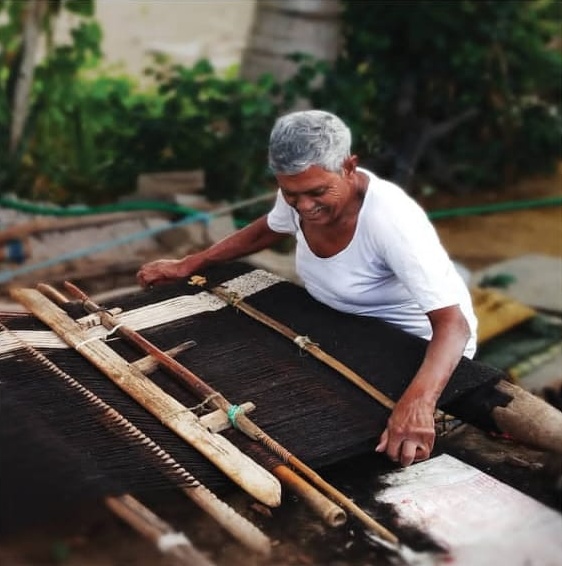
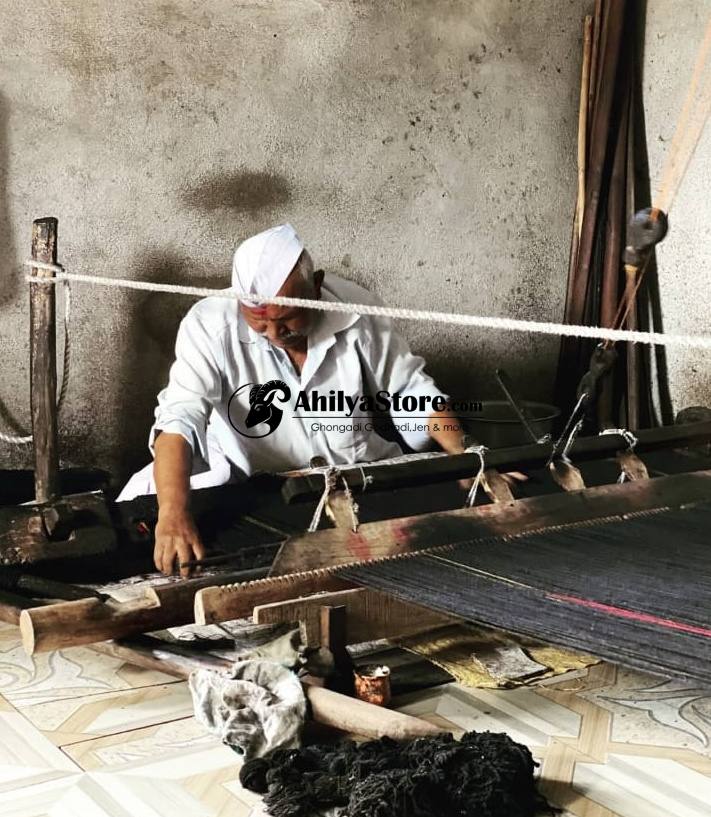
- Handmade Ghongadi: This is the original, traditional type, woven on a pit loom. It is made from 100% pure wool and is known for its durability and health benefits. Pit-loom and Hand-loom is different. A pit loom gets its name from the fact that it is installed over a small pit dug into the ground, where the weaver sits with their legs in a pit and weaving the gongadi, and Hand-loom is a self-supporting wooden frame that sits above ground; the weaver sits on a bench.
- Machinemade Ghongadi: These are modern imitations, It contain 100% Nylon, and are considered less authentic because it’s duplicate ghongadi. Currently in the market, 99% this type of blankets being sold. This is a big scam.
By Type of Wool:

- Jawal Ghongadi: The wool in jawal ghongadi is baby sheep wool. They are light weighted and used in spiritual activities as well as health purposes.
- Traditional Ghongadi: The wool in traditional ghongadi is mature sheep. They are heavy weighted and used in rain, farm activities as well as health purposes. This is not used in spiritual activities.
By Color:
- Black, White and Grey is the most common types. Which are based on the natural color of the sheep’s wool.
How is a GHONGADI / KAMBALI / KAMBLI made?
Making a Ghongadi (also known as Kambli, Kambal, or Kuri blanket) is a labor-intensive, traditional process that has remained largely unchanged for centuries. These blankets are hand-woven by shepherd communities like the Dhangars (Maharashtra), Kurubas/Kuruma (Karnataka/Andhra Pradesh/Telangana), Pal/Baghel/Gadaria (North India) using pure “Desi” sheep wool.
It is crafted using a unique, ancient process by the nomadic community. The making of a Ghongadi woollen blanket is an entirely manual, eco-friendly process that involves no electricity or modern machinery.
Here is the step-by-step process of how these blankets are made:
Washing Sheep

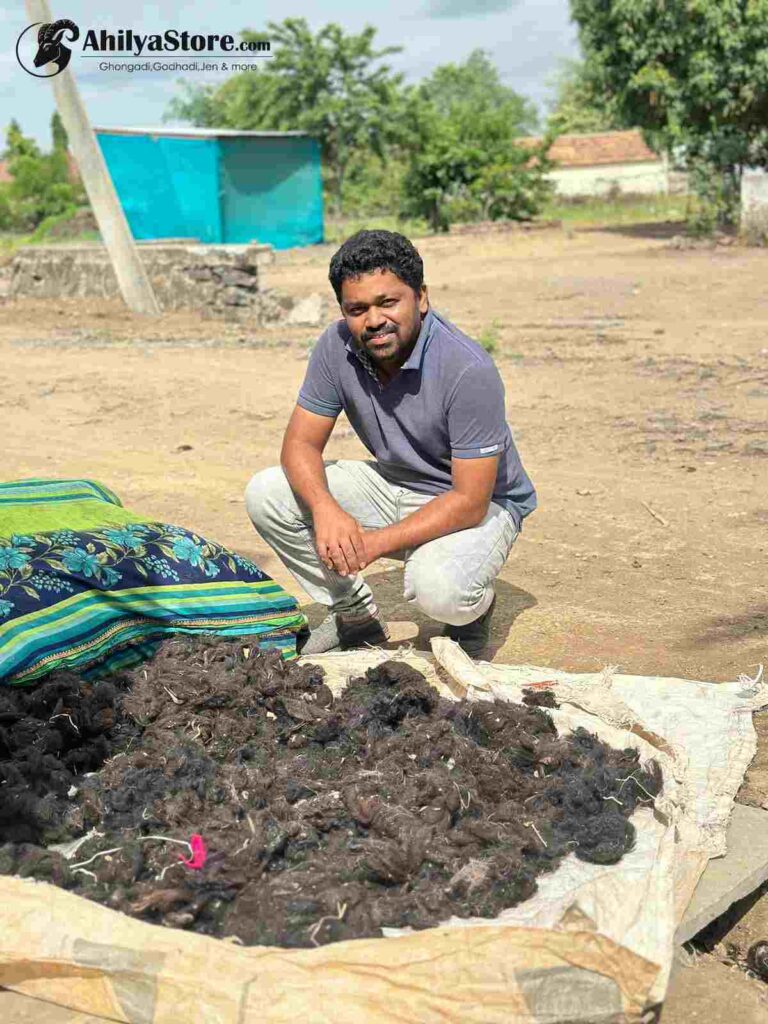
The first step before making a ghongadi (sheep woolen blanket) is washing the sheep. Instead of washing each sheep individually, the shepherds wash the entire flock in a pond, river, or stream in the village or in the open fields. Washing the sheep cleanses their wool of thorns, twigs, and mud, making the shearing process easier and simpler. Sheep shearing occurs twice a year.
Sourcing the Wool (Shearing)

The process begins with the Desi sheep (Deccani breed). Shepherds shear the wool by manually using large traditional shears. This wool is typically coarse and comes in natural colors: black, white, and grey. Unlike modern blankets, no synthetic dyes are used; the color of the Ghongadi depends on the natural color of the sheep’s wool. The wool, often from the first shearing of a young sheep, is used for “Javal” Ghongadi’s and Aasan.
Cleaning and Carding

The raw wool is full of dust and grease. It is manually cleaned and “carded” (combed) using traditional wooden tools or a bow-like instrument called “Kaman”(in marathi). In north india side some of artician used ropes. This aligns the fibers and prepares them for spinning.
Hand-Spinning

The cleaned wool is spun into yarn using a Charkha (spinning wheel) or a simple hand spindle called a Bhingari. This creates a strong, thick “Khadi” wool yarn. During India’s freedom struggle, the Swadeshi movement led to large-scale spinning of wool yarn on the charkha (spinning wheel), which accelerated the process of yarn spinning. The charkha came into use in villages across the country.
Warping & Sizing

They create a sizing mixture (Khal) from ground tamarind seeds and apply it to the warp threads to strengthen them, repeating this multiple times. This is a unique and crucial step of measuring the yarn and it has to be done in the sunlight. To make the wool durable and stiff enough for weaving, the yarn is treated with a natural starch made from tamarind seeds called Khal (in Marathi).
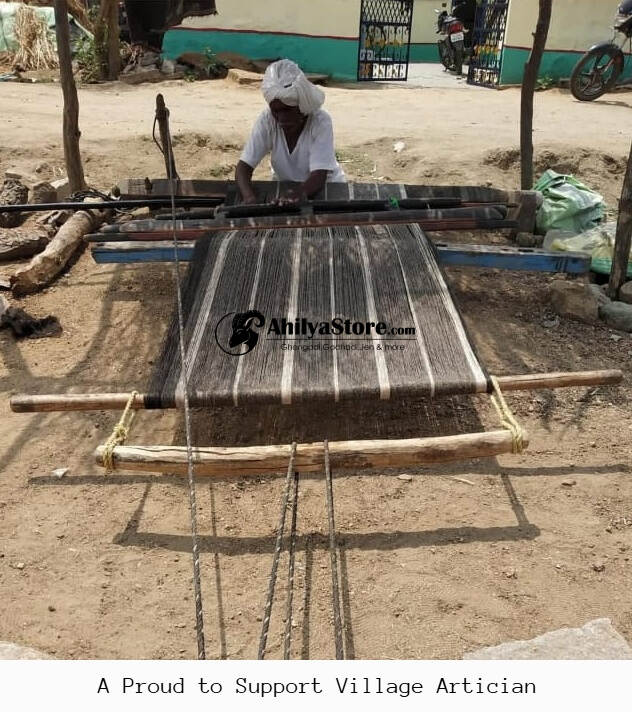
Weaving on the Pit Loom

The weaving is done on a Pit Loom (as discussed earlier).
- The weaver sits with their legs in a pit and weaving the ghongadi blankets.
- The weaving is slow; it can take 8 to 10 hours of continuous manual labor to finish just one blanket.
- A traditional Ghongadi usually features a plain black and white body with simple colorful borders (often red or yellow).
Tamarind Seed Treatment

This process coats the ghongadi blanket, making it much stronger, durable, and resistant to pests (like moths or termites). It also gives the blanket its characteristic stiffness when new. This is only applicable to traditional ghongadi (Heavy Weight).
- The seeds are roasted, peeled, and soaked for 24 hours.
- They are ground into a paste and boiled to create a thick starch called Khal (in Marathi).
Finishing and Sun-Drying

Once off the loom, the blanket is sprinkled with water and dried in the sun. This “sets” the fibers. The result is a heavy, coarse, and slightly prickly blanket that is famous for its health benefits.
Stitch a Horizontal Border (Revad Bharane)

Revad Bharane(marathi word) is a critical and labor-intensive step in the traditional Ghongadi weaving process. It means with the external yarn stitch a horizontal border manually without any instrument. The yarn is stretched out over long distances (often 20 to 30 feet) in an open field or a long corridor. This is a communal activity—usually, 3 to 4 family members or weavers work together. This method is not used even today.
It takes six to eight days to make one sheep wool blanket. These artisans from the village are still preserving tradition. They are safeguarding their legacy. When you buy from them, you are not purchasing ghongadi; you are keeping a legacy alive.
BUY WITH HEART❤️ KEEP THE STORY ALIVE🌹
How to find
Original Ghongadi (Kambal Blanket) and Duplicate Ghongadi (Synthetic Blanket)
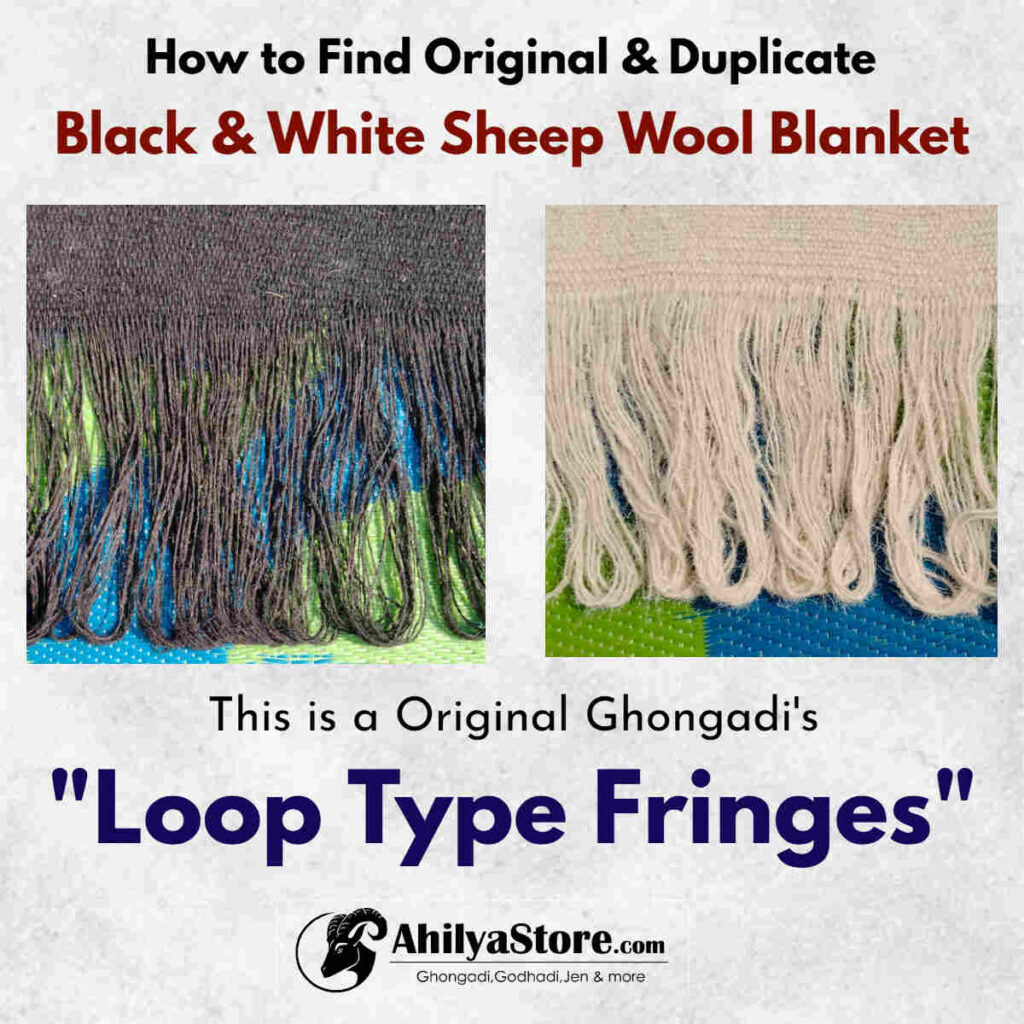
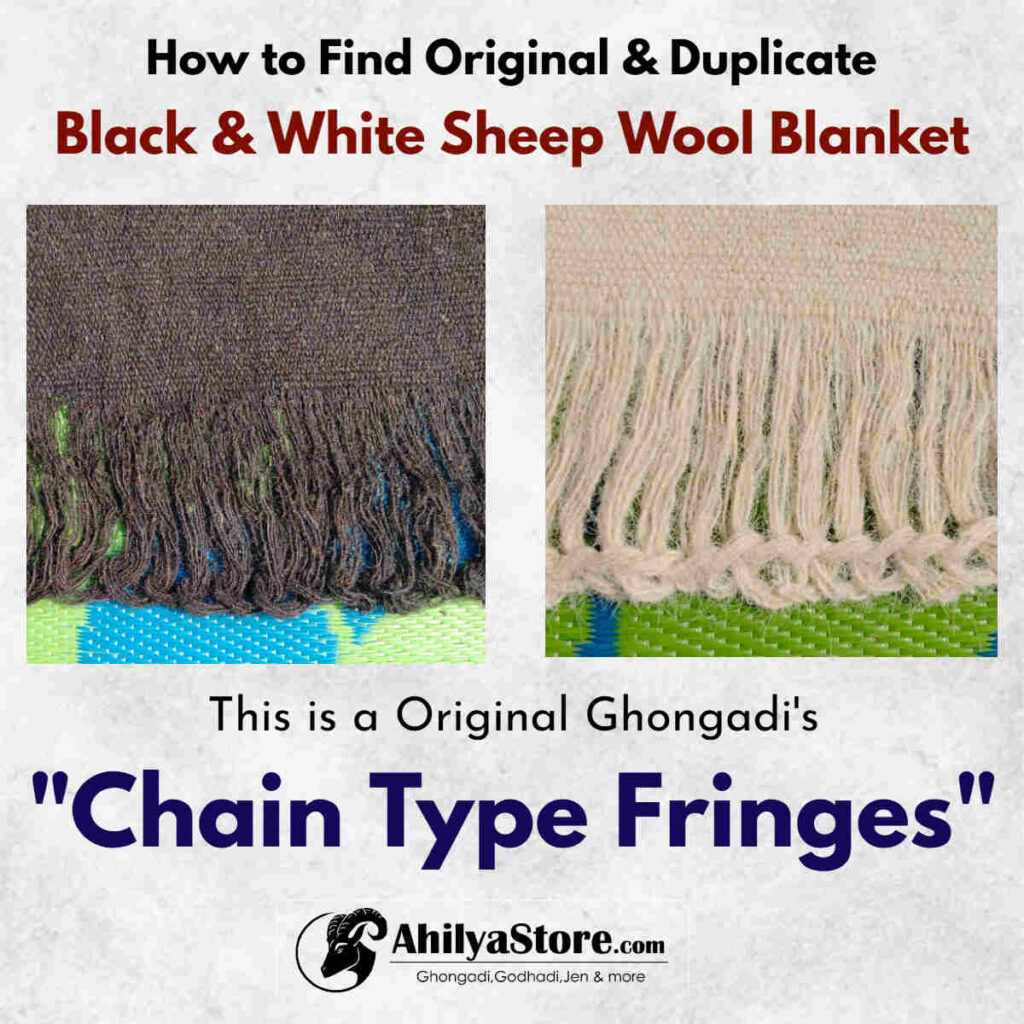
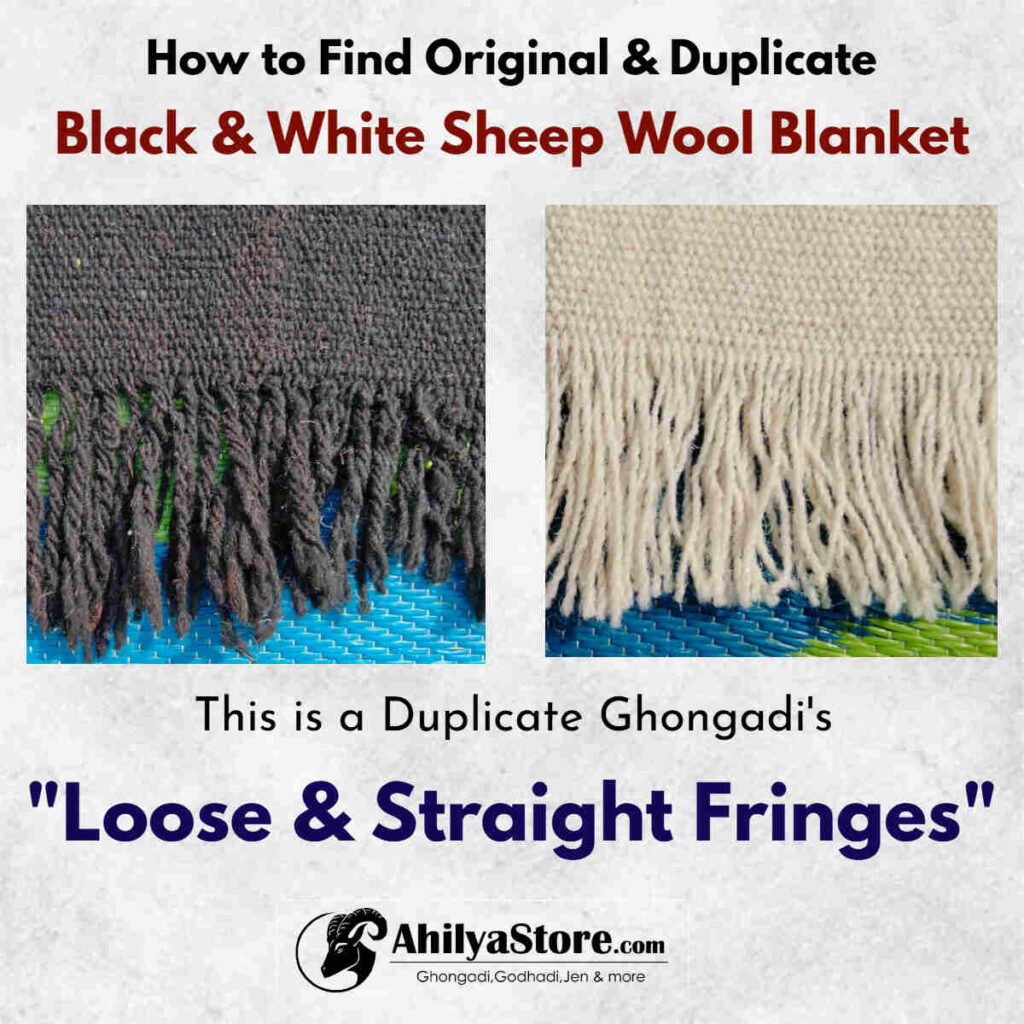
Machine-made means duplicate ghongadi, i.e. synthetic blankets. Nowadays, in the market 99% of the blankets available are machine-made, Only 1% are handwoven, which are the original ones. Machine-made blankets contain 80% of polyester fibers and 20% of others, while handwoven blankets are made entirely 100% of pure sheep wool. A simple way to distinguish between these two types of blankets is to examine the fringes. Examining the fringes of the ghongadi is a method applicable to all handmade ghongadis, i.e. Jawal and Traditional ghongadi blanket.
- Machine-made synthetic blankets have short, loosely woven fringes, and they are cut in a straight line.
- Handloom ghongadi have longer fringes that are woven in a loop or chain pattern. Currently, machine-made blankets do not have fringes woven in these two patterns. Watch the below video for more understanding.
“Loop Type Fringes”
“Chain Type Fringes”
“Loose & Straight Fringes”
About AhilyaStore.com
Ahilya Store Is Indeed One Of The Most Trusted And Specialized Platforms For Buying An Authentic Handmade Ghongadi Online, Especially If You Are Looking For A Deep Connection To Indian Legacy. We Directly Work With Artisan And Women Self-help Groups(SHGs). A Proudly Supported Local Artisan And Self Woman Group. No Middle Man. Major Revenue Shared With Them.
In 2021, We Met With Artisans From Satara, Sangli And Solapur Districts Of Maharashtra And Started Selling Authentic, Traditional Satara Weaving Style Mandeshi Ghongadi And Dhangari Jen Online.
In 2022, Artisans From Kolhapur, Dhule, And Nandurbar District Of Maharashtra Joined Us And Started Selling The Heaviest, Most Rugged “Shepherd Kolhapuri Heavyweight Style” And Rainy Ghongadi.
In 2024, Artisans From Karnataka, And Telangana Of India Are Working With Us. And Then Started Selling A Wider Variety Of Karnataka, Telangana Style Kambli Blanket And Military Gongadi Blankets Online.
In 2026, Ahilyadevi Women’s Self-help Groups Of Jalna And Udgir Of Maharashtra Joined Us And In Large Quantities Woolen Thread Began To Be Produced. The Purpose Is To Support Rural Women Entrepreneurs And SHG Group.
In The Future, We Would Like To Work With Artisans From Different States And We Are Making Efforts For That. This Is A Small And Sweet Story Of Ahilyastore.com. We Are A Non-government Organization. We Are Based In Taradgaon (Satara). This Is Our Head-place While We Have Retail Stores In Pune And Mumbai(Mahim & Kamothe). You Can Visit The Store And Feel The Ghongadi Before Buying.
Now Different Types Of Ghongadi Are Available For Online And Offline Sale Like Premium “Javal” Ghongadi, Light Weight And Heavy Weight Ghongadi And Dhangari Ghongadi-Jen, Other Sheep Wool Products Like Woolen Yoga Mat, Meditation Mat And Pooja & Prayer Mat Are Also Available.
We Deliver Ghongadi Across The India And Internationally. We Offer Free Shipping And Cod Payment Across India, Which Is Great For First-time Buyers Who Are Hesitant About Delivery. They Can Make The Order Through Amazon And Flipkart Also.
Experience The Warmth Of Tradition. Add The Ahilyastore.com Handmade Woolen Ghongadi To Your Cart Today!
Ahilya Store Is A Part Of Ahilya Group.
In Maharashtra, there is a belief prevalent in the Dhangar community since ancient times that, “A sheep is a form of Goddess Lakshmi(The deity of wealth, prosperity), and its wool is like gold”. And this is indeed true. Therefore, many private organizations, including ours, are working to promote this sheep rearing and ghongadi weaving business. In 2025, STOPMOTION FILM created a very informative video on desi wool; be sure to watch it. This video also pays tribute to Sant Balumama, as today 30% of the wool comes from Sant Balumama’s sheep.